
Pelvic Organ Prolapse: Reconstructive Surgery with Native Tissue, No Mesh
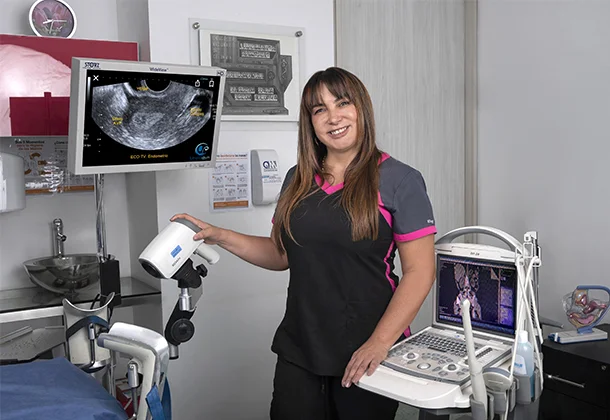
Pelvic organ prolapse: the sensation of a "bulge" or heaviness in the vagina, from the bladder, uterus or rectum dropping: is one of the most common reasons women see a gynecologist, especially after childbirth or menopause. When it affects quality of life, daily activity or sexual life, pelvic floor reconstructive surgery is the option that corrects the problem for good. At Urologyn Care we perform it with native-tissue vaginal repair: the approach that today's strongest scientific evidence supports over transvaginal mesh.
Ask about pelvic floor surgery
What is pelvic organ prolapse, and why does it happen?
The pelvic floor is the set of muscles and ligaments that support the bladder, uterus and rectum. When it weakens: from vaginal childbirth, menopause (estrogen loss), chronic constipation, chronic coughing, obesity or simply aging: these organs can descend and bulge into the vagina. The result is pelvic organ prolapse, which can come with urinary incontinence, difficulty fully emptying the bladder or rectum, and discomfort or pain during intercourse.
What does pelvic floor reconstructive surgery involve?
It isn't a single operation, but a combination of techniques your gynecologist selects and tailors to your case, always through a vaginal approach with no abdominal incision:
- Anterior and posterior colporrhaphy: reinforces the front and back vaginal wall to support the bladder and rectum.
- Vaginal colpopexy: resuspends the upper part of the vagina (the apex) to a stable support structure.
- Vaginal hysterectomy: removes the uterus when it's the cause of the prolapse; not always necessary.
- Sling cystopexy: supports the bladder and, when stress urinary incontinence is also present, adds a suburethral sling.
Does the uterus always have to come out? Not necessarily. When it can be preserved, the evidence shows no significant difference in outcomes between preserving it (hysteropexy) and removing it (hysterectomy): the decision is made together with you, based on your case and your preference (Maher et al., Cochrane Database of Systematic Reviews, 2023).
Native tissue repair: the option the evidence supports
For years, transvaginal mesh was promoted as a "permanent" reinforcement for prolapse. The most rigorous evidence available today (Cochrane reviews, the highest standard of evidence in medicine) shows otherwise:
- A Cochrane review of 59 clinical trials in 6,705 women concluded that transvaginal mesh offers no advantage over native tissue repair for apical vaginal prolapse, and is associated with a 17.5% mesh exposure rate (Maher et al., Cochrane Database of Systematic Reviews, 2023).
- A randomized controlled trial with 12-year follow-up found a reoperation rate (for recurrence, incontinence or mesh exposure) of 40% in the mesh group, versus 19% in the native tissue repair group (p = 0.03), with no difference in patient-reported improvement (Kluivers et al., International Urogynecology Journal, 2023).
That's why at Urologyn Care we prioritize native tissue repair: it's the approach the strongest evidence supports, with a lower risk of a second surgery down the line.
Request a gynecology evaluation
Native tissue vs. transvaginal mesh, by the numbers
| Native tissue (what we do) | Transvaginal mesh | |
|---|---|---|
| Proven advantage over the other technique | : | None (Cochrane, 2023) |
| Material exposure/erosion | Not applicable | 17.5% (Cochrane, 2023) |
| Reoperation at 12 years | 19% | 40% (Kluivers et al., 2023) |
What about the sling for urinary incontinence? Is that the same as mesh?
No: it's a common point of confusion, and worth clarifying. The transvaginal mesh discussed above is a broad sheet once used to reinforce prolapse repairs. The suburethral sling is a different, much smaller device (a narrow tape) designed specifically for stress urinary incontinence, not for prolapse. In fact, it's the most extensively researched surgery for this problem: a Cochrane review of 81 clinical trials in over 12,000 women describes it as having a good safety profile and effectiveness that holds up over time, with short-term subjective cure rates between 62% and 98% (Ford et al., Cochrane Database of Systematic Reviews, 2017).
When combined with prolapse surgery, the evidence shows the sling adds a specific benefit for women undergoing vaginal hysterectomy with apical suspension, reducing urinary incontinence at 5-year follow-up (Giugale et al., Female Pelvic Medicine & Reconstructive Surgery, 2022): which is why we add it only when the case calls for it, not as a routine add-on.
Who is this surgery for?
- Women with a bulge or heaviness sensation from the bladder, uterus or rectum dropping.
- Stress urinary incontinence associated with the prolapse.
- Difficulty fully emptying the bladder or rectum because of the prolapse.
- Discomfort, pelvic pain, or an impact on sexual life that affects quality of life.
Frequently asked questions
Is this open surgery, with an abdominal incision?
No. The entire approach is vaginal, with no external incision, which generally means a more comfortable recovery than open abdominal surgery.
Do you use mesh?
We prioritize native tissue repair, the approach the strongest available evidence supports (see above). The suburethral sling for incontinence, when needed, is a different, far more extensively studied device with a good safety profile.
Can I keep my uterus?
In many cases, yes. Your gynecologist will assess whether it's best to preserve or remove it based on your individual situation: the evidence shows no significant difference in outcomes between the two options when properly indicated.
How long is recovery?
It varies depending on the combination of techniques your case needs. Our medical team gives you personalized care instructions before and after surgery.
Pelvic floor reconstructive surgery at Urologyn Care
At Urologyn Care we evaluate every case individually as part of our Gynecology service in Pereira, Colombia, choosing the combination of techniques (always with native tissue repair as first line) that best corrects your prolapse and any associated incontinence. We regularly welcome international patients, from an initial virtual consultation to coordinating your visit. If you're dealing with a bulge or heaviness sensation, or urine leakage that affects your daily life, get in touch for an evaluation.
Scientific references
- Maher C, et al. "Surgery for women with apical vaginal prolapse." Cochrane Database Syst Rev. 2023. View on PubMed.
- Ford AA, et al. "Mid-urethral sling operations for stress urinary incontinence in women." Cochrane Database Syst Rev. 2017. View on PubMed.
- Kluivers KB, et al. "Subjective outcomes 12 years after transvaginal mesh versus native tissue repair in women with recurrent pelvic organ prolapse." Int Urogynecol J. 2023. View on PubMed.
- Giugale L, et al. "Long-term Urinary Outcomes After Transvaginal Uterovaginal Prolapse Repair With and Without Concomitant Midurethral Slings." Female Pelvic Med Reconstr Surg. 2022. View on PubMed.
Ready to schedule your appointment?
Our team supports you through the whole process, from your first evaluation to treatment.
Message us on WhatsApp