
ThuLEP: Thulium Laser Enucleation for an Enlarged Prostate
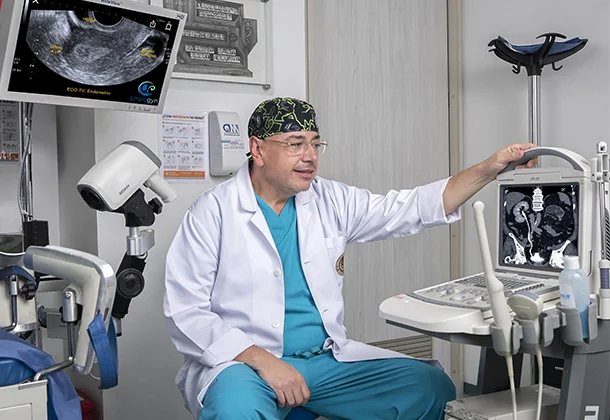
Benign prostatic hyperplasia (BPH) (an enlarged prostate) is one of the most common reasons men over 50 end up in a urologist's office. When medication no longer controls the symptoms, surgery becomes the best option for restoring normal urination. At Urologyn Care we perform ThuLEP (Thulium Laser Enucleation of the Prostate), one of the most advanced surgical techniques available today for BPH, with less bleeding and a shorter recovery than conventional surgery.
What is ThuLEP?
ThuLEP is an enucleation technique: the surgeon uses a continuous-wave Thulium laser fiber to fully separate the obstructing prostate tissue from its capsule (much like peeling a fruit) leaving the capsule itself intact. The separated tissue is then broken up inside the bladder (morcellation) and removed through the urethra, with no external incision at all.
Unlike vaporization or conventional transurethral resection (TURP), which remove tissue gradually, enucleation removes the entire obstructing adenoma as one piece, which tends to mean more durable results and a lower chance of needing a second surgery down the line.
Why a Thulium laser?
The Thulium laser emits continuously (not in pulses, like the Holmium laser used in ThuLEP's sister technique, HoLEP) allowing smoother, more progressive cuts with superior coagulation. In practice, this tends to mean less bleeding during and after surgery, a meaningful advantage for older patients, those with cardiovascular disease, or anyone on blood thinners.
Who is ThuLEP for?
- Men with obstructive urinary symptoms (weak stream, incomplete emptying, waking up several times a night to urinate) that no longer respond to medication.
- Patients with recurrent urinary retention caused by prostate growth.
- Prostates of any size: unlike conventional TURP, ThuLEP has no volume limit that would otherwise require open surgery.
- Patients on blood thinners or otherwise at higher bleeding risk, for whom minimizing blood loss is a clinical priority.
ThuLEP compared with other surgical options
| Technique | Prostate size limit | Expected bleeding | External incision |
|---|---|---|---|
| TURP (transurethral resection) | Small/medium prostates | Moderate | No |
| Open surgery (adenomectomy) | No limit | High | Yes |
| ThuLEP (Thulium laser enucleation) | No limit | Low | No |
What the scientific evidence shows
ThuLEP isn't a marketing claim: it's a technique evaluated in comparative clinical trials, including head-to-head against HoLEP (Holmium laser enucleation), the most-studied enucleation technique and the reference alternative recognized by European Urology guidelines for the surgical treatment of BPH regardless of prostate size.
- A prospective multicenter randomized trial in 236 patients found ThuLEP achieves functional outcomes equivalent to HoLEP, with a significantly smaller drop in hemoglobin (0.45 g/dL vs 2.77 g/dL, p = 0.005) and fewer episodes of acute urinary retention and incontinence in the immediate postoperative period (Bozzini et al., World Journal of Urology, 2021).
- A meta-analysis pooling 8 studies and more than 2,100 patients confirmed that ThuLEP has a better safety profile than HoLEP, with less bleeding, a shorter hospital stay and faster symptom improvement (IPSS score) at three months after surgery (Meng et al., Asian Journal of Surgery, 2022).
- In large prostates (over 100 mL) (where open surgery used to be practically the only option) ThuLEP showed shorter operative times and greater enucleation efficiency than HoLEP, with comparable complication and continence rates (Kaya et al., Andrologia, 2021).
These findings are consistent with the European Association of Urology (EAU) guidelines, which recognize laser enucleation techniques as a first-line alternative to open surgery and TURP for the surgical treatment of benign prostatic hyperplasia.
Frequently asked questions
Is ThuLEP painful?
It's performed under anesthesia (spinal or general, per the anesthesiologist's assessment) through the urethra, with no external incision at all, so postoperative pain tends to be considerably lower than with open surgery.
How much recovery time do I need?
As an outpatient, minimally invasive procedure, typical downtime is as little as one weekend, though the exact timeline depends on your individual case and your urologist's assessment.
Does ThuLEP affect sexual function?
Like most surgeries for benign prostatic hyperplasia, ThuLEP can cause retrograde ejaculation (semen goes into the bladder instead of out), an expected, painless effect. Erectile function is generally not affected by the technique. Your urologist will review this and other points with you at your initial evaluation.
Is it the same as HoLEP?
Both are laser prostate enucleation techniques and share the same surgical principle; the difference is the type of laser (continuous-wave Thulium vs pulsed Holmium). The scientific evidence shows equivalent functional outcomes between the two, with a ThuLEP advantage in bleeding and, in large prostates, operative time.
ThuLEP at Urologyn Care
At Urologyn Care we perform ThuLEP with state-of-the-art laser technology, as part of our Urology service in Pereira, Colombia. We regularly welcome international patients: if you have symptoms of an enlarged prostate and want to know if you're a candidate for this technique, message us and our team will help you plan your visit, from an initial virtual consultation to coordinating your trip.
Scientific references
- Bozzini G, et al. "A prospective multicenter randomized comparison between Holmium Laser Enucleation of the Prostate (HoLEP) and Thulium Laser Enucleation of the Prostate (ThuLEP)." World J Urol. 2021. View on PubMed.
- Meng C, et al. "Comparison of enucleation between thulium laser and holmium laser for benign prostatic hyperplasia: A systematic review and meta-analysis." Asian J Surg. 2022. View on PubMed.
- Kaya E, et al. "Laser enucleation for prostates larger than 100 mL: Comparison of HoLEP and ThuLEP." Andrologia. 2021. View on PubMed.
- European Association of Urology. "EAU Guidelines on the Management of Non-neurogenic Male LUTS." uroweb.org.
Ready to schedule your appointment?
Our team supports you through the whole process, from your first evaluation to treatment.
Message us on WhatsApp